






文章目录

英国公司注册

英国公司注册

英国公司国际法律地位崇高,...

香港公司注册

香港公司注册

香港结合了各种适合国际企业到此设立公司的诱因,...

上海 Shanghai
TEL:+86 21-6090-4391

深圳 Shenzhen
TEL:+86 755-8317-6807

台北 Taipei
TEL:+886-2-2557-5607

台中 Taichung
TEL:+886-4-2320-2793

interarea@interarea.cn

How to Set Up a Company in Singapore?

Foreign investors establishing a company in Singapore commonly choose a Private Limited Company, one of the most popular business structures for investment in Singapore.

A Private Limited Company can have up to 50 shareholders and is a separate legal entity from its shareholders and directors. Each shareholder’s liability is generally limited to the amount of capital invested in the company.

Shareholders have limited liability for the company’s debts and losses. The company name typically ends with “Pte Ltd” or “Ltd.”

新加坡註冊

I. Introduction to Singapore

Singapore has a well-established legal system, advanced infrastructure, and a strong international reputation, with close ties to countries across the region.

It offers a highly business-friendly environment and is recognized as one of the world’s most competitive economies.

Singapore also has a simple and competitive tax system. It generally does not impose tax on capital gains or dividends received by shareholders, making it an attractive destination for entrepreneurs and businesses seeking new opportunities.

II. Advantages of Registering a Company in Singapore

Singapore has an export-oriented economy and is a globally recognized hub for international trade and finance. Attracting foreign investment has long been a key part of its economic strategy.

Singapore has consistently ranked among the world’s leading business and investment destinations. Its key advantages include:

Strategic Location

Located along major international shipping routes, Singapore has a natural deep-water harbor.

Diverse Financing

As a major international financial center, Singapore provides businesses with access to global capital and diverse financing opportunities.

Infrastructure

Singapore offers world-class ports, airports, broadband infrastructure, and telecommunications networks.

Legal System

A well-established legal and dispute resolution system provides a reliable framework and protection for investors.

Political & Social

Singapore is known for its safe environment, low crime rate, and stable political and social conditions.

Efficient Government

Singapore’s government is recognized for efficiency and transparency, providing streamlined services.

Business Network

Singapore has a highly diversified economy covering a broad range of industries, creating extensive.

Business Incentives

Singapore offers various policies and incentives to support economic growth, with many programs available to both local.

III. What Are the Benefits and Functions of Setting Up a Company in Singapore?

Setting up a company in Singapore is relatively simple and efficient, supported by a clear and well-established corporate legal framework. Key benefits include:

  • Apply for Singapore Work Passes: A company may apply to Singapore’s Ministry of Manpower (MOM) for an Employment Pass (EP) for eligible foreign executives who plan to work in Singapore.
  • A Singapore company can conduct local business, register with Singapore Customs for import and export activities, and register for GST where applicable.
  • Companies can legally employ staff in Singapore and make the required CPF contributions for eligible employees.
  • Singapore has a strong global reputation, and its ASEAN membership makes it a strategic base for businesses expanding into Southeast Asian markets.

IV. Singapore Tax System and Tax Rates

Investors choose Singapore for many reasons.

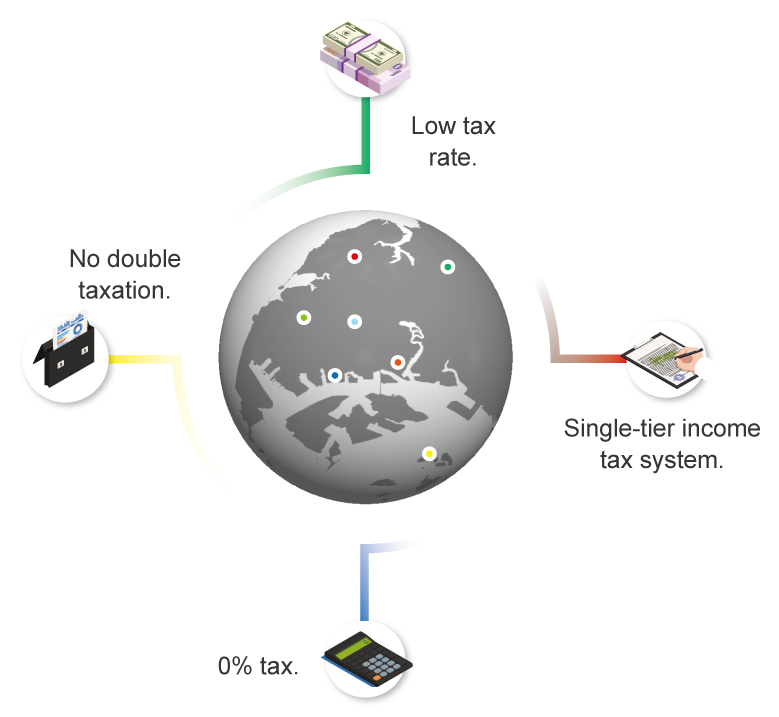
In addition to its ease of doing business and strong support for international operations, Singapore’s tax system is a major attraction. It is known for competitive corporate and personal tax rates, tax incentives, no capital gains tax, a one-tier corporate tax system, and an extensive network of double taxation agreements.

Key features of Singapore’s corporate tax system include:

新加坡設立
  • One-Tier Corporate Tax System:
    Since January 1, 2003, Singapore has adopted a one-tier corporate tax system. Tax paid by a company on its chargeable income is final, and dividends distributed from after-tax profits to shareholders are generally tax-exempt.
  • Tax Exemptions:
    Capital gains are generally not subject to tax. Certain foreign-sourced income may also qualify for tax exemption, subject to applicable conditions. Singapore does not impose inheritance or gift tax.
  • Competitive Tax Rates:
    Singapore’s corporate income tax rate is capped at 17%. Various tax exemptions and incentive schemes may further reduce a company’s effective tax rate.
  • Avoidance of Double Taxation:
    Singapore has an extensive network of Double Taxation Agreements (DTAs) with countries worldwide. Eligible foreign-sourced income may benefit from foreign tax credits or treaty relief, helping businesses avoid double taxation. Unilateral tax credits may also be available for certain foreign-sourced income from non-treaty jurisdictions.

Singapore also provides various incentives to encourage investment in emerging industries, research and development, innovation, and productivity-enhancing technologies.

  • Singapore generally follows a territorial tax system, under which companies and individuals are primarily taxed on income sourced in Singapore, subject to the applicable rules for foreign-sourced income.

V. What Types of Business Entities Can Be Registered in Singapore?

Singapore law allows various types of business entities, including sole proprietorships, partnerships, public limited companies, and private limited companies. Among these, the Private Limited Company is the most common structure.

手機板廣告 新加坡
  • Private Limited Company

A Private Limited Company is a separate legal entity from its shareholders and directors. Shareholders generally have limited liability and are not responsible for the company’s debts and losses beyond the amount invested in the company.
A Private Limited Company may sue or be sued and can own property in its own name. Its shares are privately held and are not offered to the public. A Singapore Private Limited Company may have up to 50 shareholders and can be 100% locally or foreign-owned.

  • Subsidiary Company

A subsidiary is also a Private Limited Company and is a separate legal entity from its parent company. This generally means that the parent company is not directly liable for the subsidiary’s debts or legal obligations.
Singapore allows 100% foreign ownership, so a foreign company may own all shares in a Singapore subsidiary or share ownership with local or other foreign entities. The subsidiary generally files its own annual return separately from its parent company.

  • Exempt Private Company

An Exempt Private Company (EPC) is a private company whose shares are not directly or indirectly held by another corporate entity.
To qualify as an EPC, a Singapore Private Limited Company must generally meet the following conditions: it must have no more than 20 shareholders, and none of its shareholders may be corporate entities. EPCs may also enjoy greater flexibility in certain financial and lending arrangements.

VI. Documents and Requirements for Singapore Company Registration

  • Company Name:

The proposed company name must be provided in English. Chinese names are not accepted for registration. The company name must end with “Private Limited” or “Pte. Ltd.”

  • Shareholders:

Shareholders may be individuals or corporate entities. There are no restrictions on foreign ownership, allowing foreign individuals or companies to hold 100% of the shares. A Singapore company may have 1 to 50 shareholders, and shareholders may also serve as directors.

  • Directors:

Directors must be individuals; corporate entities cannot act as directors. The company must have at least one Singapore resident director. A resident may be a Singapore citizen, Singapore permanent resident, or eligible Employment Pass holder. In practice, companies may appoint two directors—one foreign director and one local resident director.

  • Company Secretary:

Under Section 171 of the Singapore Companies Act, a Singapore company must appoint a local company secretary.

  • Share Capital:

There is generally no specific maximum share capital requirement for a Singapore company. A standard share capital of SGD 100,000 may be adopted depending on the company’s needs. If the share capital exceeds SGD 500,000, additional fees related to membership in the Singapore Business Federation (SBF) may apply.

VII. Important Considerations for Singapore Company Registration

When registering a company in Singapore, the following requirements and restrictions should be considered:

  1. The proposed name should not be identical to an existing business name, particularly within the same industry.
  2. Names considered vulgar, obscene, offensive, or otherwise undesirable are not permitted.
  3. Names prohibited by order of the Minister for Finance cannot be registered.
  4. Singapore companies are not permitted to issue bearer shares.
  5. A company must appoint at least one director who is legally resident in Singapore and have at least one shareholder. Shareholders may be individuals or corporate entities, while directors must be individuals.
  6. At least one company secretary must be appointed within six months after incorporation.
  7. Information and records relating to the company’s directors and shareholders must be properly maintained and made available as required by law.
  8. Certain regulated industries, such as banking, insurance, and securities brokerage, require specific licences before commencing business. Special licences may also be required for the manufacture of certain regulated products.
  9. The company must maintain a physical registered office address in Singapore. It may be a residential or commercial address but cannot be a P.O. Box.

VIII. Singapore Company Registration Process

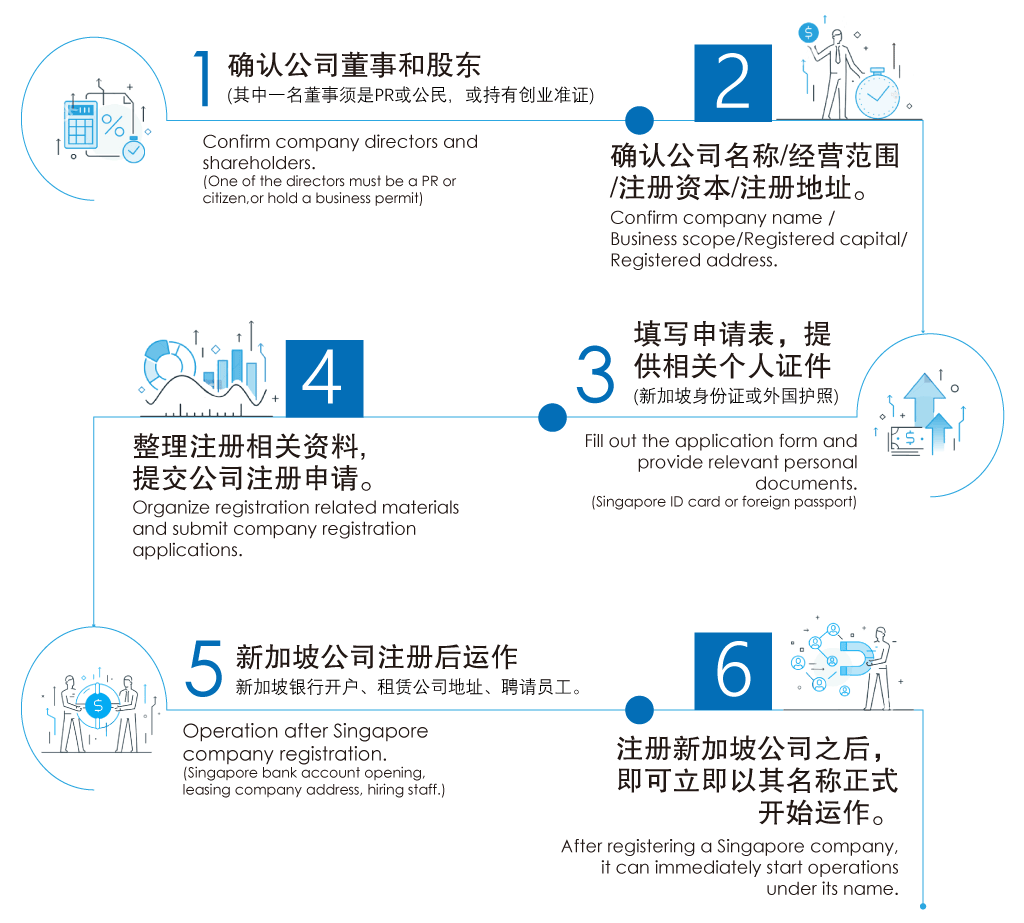
  • The Singapore company registration process generally involves the following six steps:
成立新加坡公司注册流程
  1. Confirm the Directors and Shareholders
    (At least one director must be a Singapore citizen, Permanent Resident (PR), or an eligible pass holder.)

  2. Determine the company name, business activities, share capital, and registered office address.

  3. Complete the Application Form.
    (Provide the required personal identification documents, such as a Singapore ID or foreign passport.)

  4. Submit the Registration Application.
  5. Set Up Business Operations.
    (After registration, arrange corporate banking, office premises, and employee recruitment as needed.)
  6. Once incorporated, the company may officially begin operating under its registered name.
新加坡註冊01

1.Confirm the Directors and Shareholders
(At least one director must be a Singapore citizen, Permanent Resident (PR), or an eligible pass holder.)

新加坡註冊02

2.Determine the company name, business activities, share capital, and registered office address.

新加坡註冊03

3.Complete the Application Form. (Provide the required personal identification documents, such as a Singapore ID or foreign passport.)

新加坡註冊04

4.Prepare the required documents and submit the company registration application.

新加坡註冊05

5.Set Up Business Operations. (After registration, arrange corporate banking, office premises, and employee recruitment as needed.)

新加坡註冊06

6.Once incorporated, the company may officially begin operating under its registered name.

IX. Singapore Company Incorporation Services

  • Singapore company registration generally requires the support of a qualified corporate service provider. With growing international business needs, InterArea goes beyond basic company incorporation and tax services by providing integrated, one-stop local support for businesses and individual investors.
  • InterArea provides the following professional services:

X. Singapore Company Registration FAQs | Q&A

Q1. Can foreigners own 100% of a Singapore company?

Q2. How long does it take to register a company in Singapore?

Q3. Is a local director required for a Singapore company?

Q4. Is a company secretary required for a Singapore company?

Q5. Can a director also serve as the company secretary?

Q6. What business activities can a Singapore company conduct?

Related topics